Download Microsoft Visual Studio 2010 Mac Os
- Download Microsoft Visual Studio 2010 Mac Os Iso
- Download Microsoft Visual Studio 2010 Mac Os Versions
- Microsoft Visual Studio 2010 For Mac Os X Free Download
- Download Microsoft Visual Studio 2010 Mac Os 64-bit
Hands On Microsoft this week opened the gates on Visual Studio for Mac 2019 8.3, a flexible development environment for .NET, and The Reg can give you the lowdown on some of the new features.
But first, let's see how the Microsofties got here. Redmond has three coding tools under the Visual Studio brand, all of which have different ancestries.
Visual Studio on Windows supports development not only in .NET languages but also C++, Python, JavaScript and Node.js, and cross-platform mobile development using Xamarin, Apache Cordova or C++. Depending on which edition you have, you also get SQL Server database tools, test and coverage frameworks, Microsoft Office and SharePoint development, R for data science work, built-in Docker tools and more.
Visual basic 6 0 free download - Apple Mac OS Update 9.0.4, Corel WordPerfect 6.0-8.0 Import Filter for PageMaker, Real Studio, and many more programs.
Xamarin is a cross-platform .NET framework designed mainly for iOS and Android, but also with support for macOS applications. A confusing thing is that Xamarin does not use .NET Core, though it does support the .NET Standard 2.1 specification in its latest version. See here for guidance.
8/10 (324 votes) - Download Visual Studio 2010 Free. Download Visual Studio 2010, a development environment specialized in Windows systems. Design and develop programs and applications with Visual Studio 2010. Programmers that commonly use Windows will be very familiar with Visual Studio 2010. Personally I prefer Xcode when coding on a Mac. It's not hard to learn, but because it is fairly new there aren't many useful videos or articles on how to navigate Visual Studio Code. If you are familiar with Visual Studio IDE for Microsoft Windows, Visual Studio Code is a totally different program. The software is used for any applications and any platform and any development. Microsoft visual studio 2010 ultimate is the integrated development environment. The development tool can be used for developing computer programs, web apps, websites, mobile apps and web services. Debugger and code editor is included in the software. This will enable the development. The centerpiece of Visual Studio for Mac OS X is its native implementation of Apple’s preferred object-oriented programming language, Objective-C, which is used by both Mac OS X and iPhone/iPad developers. According to Ballmer, the new Visual objective-C IDE will also appear in Visual Studio 2010 SP1 for Windows. Microsoft Visual Studio 2010 Professional, Parallels Desktop 5 Crack + Serial Key(mac), How To Intsall Stellar Phoenix Mac Data Recovery 6, Photoshop Elements 8 For Windows The Missing Manual.
Xamarin evolved from the open-source Mono framework, an implementation of .NET for Windows and Linux. Mono had its own IDE, called MonoDevelop, which unlike Visual Studio was originally written entirely in C#. Xamarin adapted MonoDevelop to become Xamarin Studio. When Microsoft acquired Xamarin in 2016, Xamarin Studio became a Mac-only IDE and was renamed Visual Studio for Mac. You can still get MonoDevelop for Mac, Windows and Linux, though the Mac download is now Visual Studio for Mac, and on Windows you have to build it from source.
Visual Studio Code (VS Code) is a cross-platform editor built with the Electron framework, using Node.js and the Chromium browser engine Blink. VS Code was first previewed in 2015 and has been a remarkable success, now ranking as the top development environment on the popular coding Q&A site StackOverflow by a huge margin. Although lightweight in comparison to Visual Studio, VS Code straddles the boundary between an editor and an IDE, with debugging support and a rich range of extensions.
Following the acquisition, Microsoft has been working on sharing some of its Visual Studio for Windows technology with the Mac version. This goes alongside the development of the cross-platform .NET Core, which has allowed code sharing between Mono and .NET Core, though Mono has not been completely replaced. It is still the case that Visual Studio for the Mac is a very different thing from Visual Studio for Windows.
What can Visual Studio for Mac do?
VS Mac is primarily for Xamarin development. The majority of Xamarin developers code applications for iOS and Android, and there are two different approaches to this.
Xamarin.iOS and Xamarin.Android let you write non-visual code in C# while using native tools to build the UI, Xcode for iOS or a built-in Android designer for Android.
Xamarin Forms is a cross-platform GUI framework. You design the user interface with XAML and build for your chosen target platforms.
You can also go beyond iOS and Android. Xamarin.Mac is for Cocoa applications and uses a similar model to Xamarin.iOS. Xamarin Forms can also target Windows UWP (Universal Windows Platform) and, in preview, macOS.
There is also steadily improving support for games development with Unity.
A glance at the Xamarin forums gives a crude guide to usage. Xamarin Forms has more than double the activity of any other section (over 51,000 threads). Xamarin.Android 34,000, Xamarin.iOS 21,000, and relatively low activity elsewhere – 343 threads for Xamarin.Mac, for example.
Download Microsoft Visual Studio 2010 Mac Os Iso
Xamarin Forms Mac support seems to be moribund; it was announced in 2017 but the platform status here was last updated in May 2018 and remains incomplete.
Visual Studio for the Mac also supports ASP.NET Core development using Razor, Angular or React.js, and serverless with Azure Functions.
Under the Vulture's Claw
A cross-platform Xamarin Forms app running on iOS and Android
We installed VS Mac on a 2018 Mac Mini. The installer pulls down the Android SDK for you, but you have to install Xcode separately. All straightforward, but there is a puzzle about .NET Core. Version 3.0 is installed automatically, and you can create ASP.NET Core apps, but when you go to create a mobile app, the option to create an ASP.NET Core API back end is disabled because it 'requires an ASP.NET Core installation'.
The look and feel of the IDE is different from Visual Studio on Windows, as you would expect from the product history. It feels more basic and less refined, and has only a fraction of the features of its similarly named cousin.
There is no visual designer for Xamarin Forms, but there is a visual preview. Unfortunately, this did not work for iOS on our very simple demo app, showing instead a MonoTouch exception message. But the app itself worked fine on both Android and iOS. The IDE did crash once or twice but with no loss of work.
Another experiment was to create a Xamarin.Mac application and edit the generated storyboard, which defines the user interface using Xcode. This worked perfectly.
What's new?
VS Mac 8.3 supports .NET Core 3 and C# 8.0, and Xamarin now supports Android 10, Xcode 11 and iOS 13.
One of the big new features, though in preview, is XAML hot reload in Xamarin Forms. This lets you amend the XAML file defining your UI, save it, and see the changes instantly in the app running on an emulator or device.
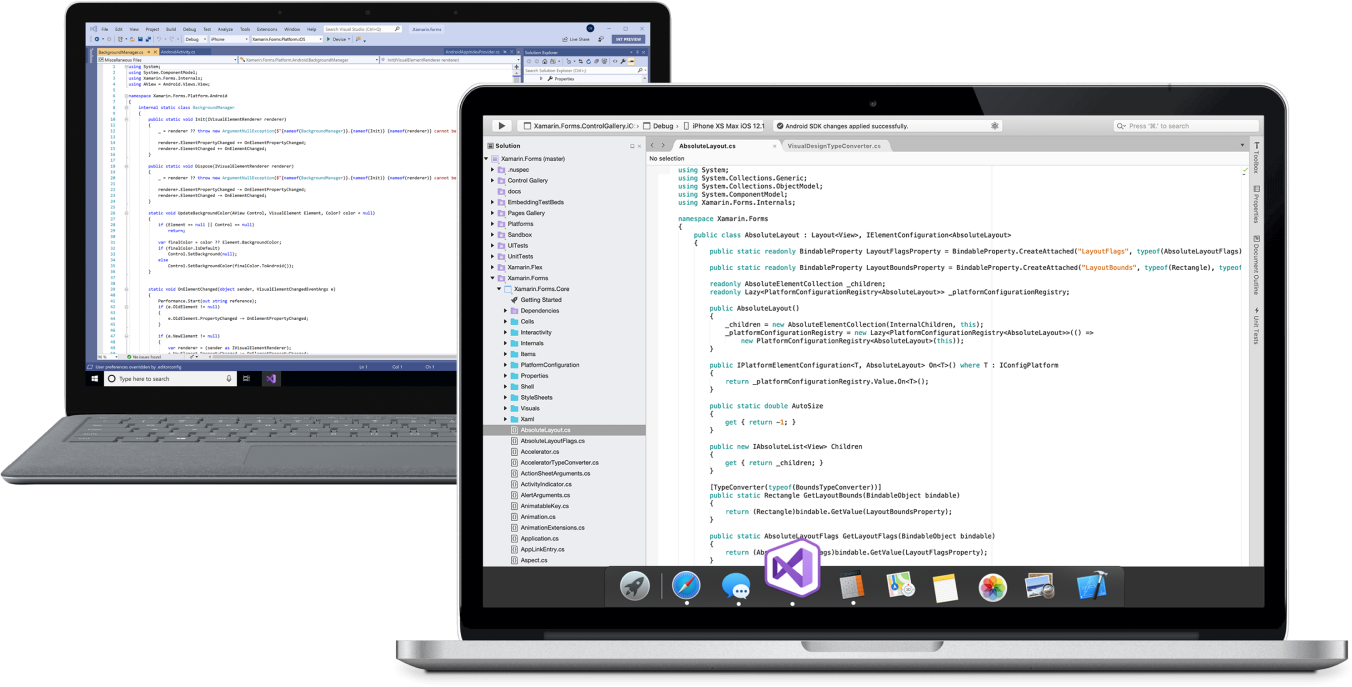
The Visual Studio Mac native editor shares code with Visual Studio on Windows
The C# editor in VS Mac was rewritten by the Visual Studio team after the Microsoft acquisition. It now has what Microsoft calls a 'fully native UI', raising the interesting question of how much of the old MonoDevelop code, which used cross-platform Gtk#, remains in VS Mac. The new native editor was fully released in July, but VS Mac 8.3 now supports web editing (JavaScript, TypeScript, HTML, CSS and more). This lets Microsoft share more features between Visual Studio on Windows and VS Mac, including improved IntelliSense. You also get proper bidirectional text support and a natty feature called multi-caret editing that lets you overtype multiple regions of selected text simultaneously.
There is a new dialog for the NuGet package manager, but care is needed because not all NuGet packages will work on the Mac.
These are highlights; the full list of what's new is here.
Observations
Microsoft has two successful Visual Studio development tools, and then there is VS Mac, which is important only for Mac-based Xamarin developers. Xamarin.Mac and Xamarin Forms targeting macOS are both interesting for .NET developers wondering how to get their Windows apps onto a Mac, but both are neglected relative to iOS and Android. If you want to develop for ASP.NET Core you would be better off with Visual Studio on Windows, and probably better off with VS Code with its much larger community and rich extension support. Strategically, it might make sense for Microsoft to invest in making VS Code more useful for Xamarin developers. All that said, VS Mac is substantially improved and the price is right: even the free Community edition is a capable tool. ®
Windows
Release 4.3.2
Download and extract one of the followings:
OSX
You need Brew installed and configured https://brew.sh/
czmq and zyre are also available.
Linux
Fedora
Ubuntu/Debian/Mint
Arch
SUSE
Packages for Debian, Ubuntu, Fedora, CentOS, RHEL, SUSE
The ZeroMQ maintainers provide pre-built binary packages for libzmq, czmq, zyre, malamute, zproject and zproto, automatically built from both the latest stable releases OR the latest commit in the Git repositories via the Open Build Service for i386, amd64, armv7, arm64, ppc64, s390x (note: depends on the distribution).
Add the repository of your choice by clicking on the distribution and version, and then follow “Go to download repository”. That is the URL of the repository. Remember to add the GPG key.
For example, to add Debian 9 and install the development packages for libzmq from the latest stable release without draft APIs:
Install from a package manager
Linux
Deb packages are available for Debian and Ubuntu.
For other distros please refer to pkgs.org.
You can also get prebuild binaries for latest git master for most distros on openSUSE’s Build Service:
Git master only stable APIs:http://software.opensuse.org/download.html?project=network%3Amessaging%3Azeromq%3Agit-stable&package=czmq
Git master including draft APIs:http://software.opensuse.org/download.html?project=network%3Amessaging%3Azeromq%3Agit-draft&package=czmq
MacOS
On macOS install czmq with Homebrew see here.
Windows
Using vcpkg
If you are already using vcpkg, you can download and install czmq with one single command:
this will build czmq as a 32-bit shared library.
this will build czmq as a 64-bit static library.
You may also build czmq with one or more optional libraries:
this will build czmq with libcurl, libmicrohttpd, lz4, as a 64-bit shared library.
To use the draft APIs, you may build czmq with draft feature:
If you are an adventurer, and want to always use the lastest version of czmq, pass an extra --head option:
These commands will also print out instructions on how to use the library from your MSBuild or CMake-based projects.
Requirements
ZeroMQ 2.2.x or later. We recommend to use ZeroMQ >= 3.C++11 compliant compiler. (g++ >= 4.7)
Download Microsoft Visual Studio 2010 Mac Os Versions
The command line client and the tests also require libboost.
Installation
Installation can be done by the standard make && make install. If the boostunittest framework is installed, check and installcheck can be run for sanitychecking. To use ZMQ4 security feature install libsodium and libzmq –with-libsodiumas shown below before ZMQPP.
git clone git://github.com/jedisct1/libsodium.gitcd libsodium./autogen.sh./configure && make checksudo make installsudo ldconfigcd ../
git clone git://github.com/zeromq/libzmq.gitcd libzmq./autogen.sh./configure –with-libsodium && makesudo make installsudo ldconfigcd ../
git clone git://github.com/zeromq/zmqpp.gitcd zmqppmakemake checksudo make installmake installcheck
The most commonly useful overrides are setting CXX, to change the compilerused, and PREFIX to change install location. The CXX prefix should be used onall targets as the compiler version is used in the build path. PREFIX is onlyrelevant for the install target.
Building and installation
Building requires a recent version of CMake (2.8.12 or later for Visual Studio, 2.8 or later for the rest), and a C++ compilerwhich supports C++11. Currently this has been tested with -* Xcode 5.1 on OS X 10.8* Xcode 6 on OS X 10.9* Xcode 6.4 on OS X 10.10* Xcode 7.1 on OS X 10.11* GCC 4.8 + Boost 1.48 on CentOS 6* GCC 4.8 + Boost 1.53 on CentOS 7* GCC 4.8 on Arch Linux and Ubuntu* GCC 4.8 on Ubuntu* GCC 5.3 + Boost 1.60 on Ubuntu* Microsoft Visual Studio 2013 on Windows Server 2008 R2
Library dependencies are -* Boost 1.48 or later* ZeroMQ 4.0.x
Tests and example code require -* Boost 1.54 or later
To build on Linux / OS X -
To build on Windows -
You can also open Visual Studio solution from build directory after invoking CMake.
To change the default install location use -DCMAKE_INSTALL_PREFIX when invoking CMake.
To change where the build looks for Boost and ZeroMQ use -DBOOST_ROOT=<my custom Boost install> and -DZMQ_ROOT=<my custom ZeroMQ install> when invoking CMake. Or set BOOST_ROOT and ZMQ_ROOT environment variables.
Install
You can install chumak from hex.pm by including the following in your rebar.config:
where X.Y.Z is one of the release versions.
Microsoft Visual Studio 2010 For Mac Os X Free Download
For more info on rebar3 dependencies see the rebar3 docs.
Requirements
zmq4 is just a wrapper for the ZeroMQ library. It doesn’t include thelibrary itself. So you need to have ZeroMQ installed, including itsdevelopment files. On Linux and Darwin you can check this with ($ isthe command prompt):
The Go compiler must be able to compile C code. You can check thiswith:
You can’t do cross-compilation. That would disable C.
Install
go get github.com/pebbe/zmq4
Install
Dependencies
For CZMQ master
A Note on Build Tags
The CZMQ library includes experimental classes that are not built by default, but can be builtby passing --enable-drafts to configure. Support for these draft classes are being addedto goczmq. To build these features against a CZMQ that has been compiled with --enable-drafts,use go build -tags draft.
For CMZQ = 4.2
Note: CZMQ 4.2 is has not been released yet.
For CZMQ Before 4.0
Usage
Maven
Add it to your Maven project’s pom.xml:
Ant
To generate an ant build file from pom.xml, issue the following command:
Install ZeroMQ.js with prebuilt binaries:
Requirements for prebuilt binaries:
- Node.js 10.2+ or Electron 3+ (requires a N-API version 3+)
Prebuilt binaries
The following platforms have a prebuilt binary available:
- Linux on x86-64/armv7/armv8 with libstdc++.so.6.0.21+ (glibc++ 3.4.21+), for example:
- Debian 9+ (Stretch or later)
- Ubuntu 16.04+ (Xenial or later)
- CentOS 8+
- Linux on x86-64 with musl, for example:
- Alpine 3.3+
- MacOS 10.9+ on x86-64
- Windows on x86/x86-64
If a prebuilt binary is not available for your platform, installing will attempt to start a build from source.
Building from source
If a prebuilt binary is unavailable or if you want to pass certain options during build, you can build this package from source.
Make sure you have the following installed before attempting to build from source:
- Node.js 10+ or Electron 3+
- A working C++17 compiler toolchain with make
- Python 2.7 (or Python 3 with Node 12.13+)
- CMake 2.8+
- curl
To install from source
If you want to link against a shared ZeroMQ library, you can build skip downloading libzmq and link with the installed library instead as follows:
If you wish to use any DRAFT sockets then it is also necessary to compile the library from source:
Downloading
Unless you specifically want to develop PyZMQ, we recommend downloadingthe PyZMQ source code or wheels fromPyPI,or install with conda.
You can also get the latest source code from our GitHub repository, butbuilding from the repository will require that you install recent Cython.
Building and installation
Download Microsoft Visual Studio 2010 Mac Os 64-bit
For more detail on building pyzmq, see our Wiki.
We build wheels for OS X, Windows, and Linux, so you can get a binary on those platforms with:
pip install pyzmq
but compiling from source with pip install pyzmq should work in most environments.Especially on OS X, make sure you are using the latest pip (≥ 8), or it may not find the right wheels.
If the wheel doesn’t work for some reason, or you want to force pyzmq to be compiled(this is often preferable if you already have libzmq installed and configured the way you want it),you can force installation with:
pip install –no-binary=:all: pyzmq
When compiling pyzmq (e.g. installing with pip on Linux),it is generally recommended that zeromq be installed separately,via homebrew, apt, yum, etc:
sudo apt-get install libzmq3-dev
sudo yum install libzmq3-devel
If this is not available, pyzmq will try to build libzmq as a Python Extension,though this is not guaranteed to work.
Building pyzmq from the git repo (including release tags on GitHub) requires Cython.
Installation
Install libzmq.
If the gem installation complains that it cannot find libzmq or headers, simply pass the location of your libzmq installation to the gem install command:
On Windows add a parameter for the libs. For example:
rust-zmq is available from crates.io. Usersshould add this to their Cargo.toml file:
As rust-zmq is a wrapper around libzmq, you need a build of libzmqversion 4.1 or newer, before attempting to build the zmqcrate. There are several options available:
Dynamic linking using pkg-config
This is probably the preferred method when you are running a recentUnix-like OS that has support for pkg-config. For example, on recentDebian-based distributions, you can use the following command to getthe prerequiste headers and library installed:
If your OS of choice does not provide packages of a new-enough libzmq,you can install it from source; seehttps://github.com/zeromq/libzmq/releases, although in this case,you may prefer a vendored build, which automates that, see below.
The build normally uses pkg-config to find out about libzmq’slocation. If that is not available, the environment variableLIBZMQ_PREFIX (or alternatively, LIBZMQ_LIB_DIR andLIBZMQ_INCLUDE_DIR) can be defined to avoid the invocation ofpkg-config.
Windows build
When building on Windows, using the MSCV toolchain, consider thefollowing when trying to link dynamically against libzmq:
- When building
libzmqfrom sources, the library must be renamedtozmq.libfrom the auto namedlibzmq-v***-mt-gd-*_*_*.lib,libzmq.lib,libzmq-mt-*_*_*.lib, etc. - The folder containing the
*.dll(dynamic link library)referred to byzmq.libmust be accessible via the path forthe session that invokes the Rust compiler. - The name of the
*.dllin question depends on the build systemused forlibzmqand can usually be seen when openingzmq.libin a text editor.
Vendored build
Starting with the upcoming release 0.9.1 (or when building fromcurrent master), you can enable the vendored feature flag to havelibzmq be built for you and statically linked into your binarycrate. In your Cargo.toml, you can give users the option to do sousing a dedicated feature flag:
Cross-compilation
When you have a cross-compiled version of libzmq installed, youshould be able to cross-compile rust-zmq, assuming a platformsupporting pkg-config. For example, assuming you have libzmqcompiled for the i686-pc-windows-gnu target installed in~/.local-w32, the following should work:
Cross compilation without pkg-config should work as well, but youneed set LIBZMQ_PREFIX as described above.